
Table of Contents
If your teeth look a little dull after years of coffee, tea, red wine, or simply getting older, it is understandable to look for an inexpensive fix in the kitchen cabinet. Search results are filled with suggestions involving baking soda, lemon juice, strawberries, charcoal, coconut oil, and hydrogen peroxide.
But “natural” does not automatically mean safe for your teeth.
Some teeth whitening home remedies may help remove surface stains, while others have little evidence behind them or can be abrasive or acidic enough to harm enamel. The American Dental Association (ADA) specifically cautions that many DIY whitening methods have limited evidence for effectiveness and may create oral-health risks.
This guide separates popular teeth whitening home remedies from methods that are actually supported by dental evidence. You will learn what may help, what to avoid, when an over-the-counter whitening product makes more sense, and when it is worth seeing a dentist.
Do Teeth Whitening Home Remedies Really Work?
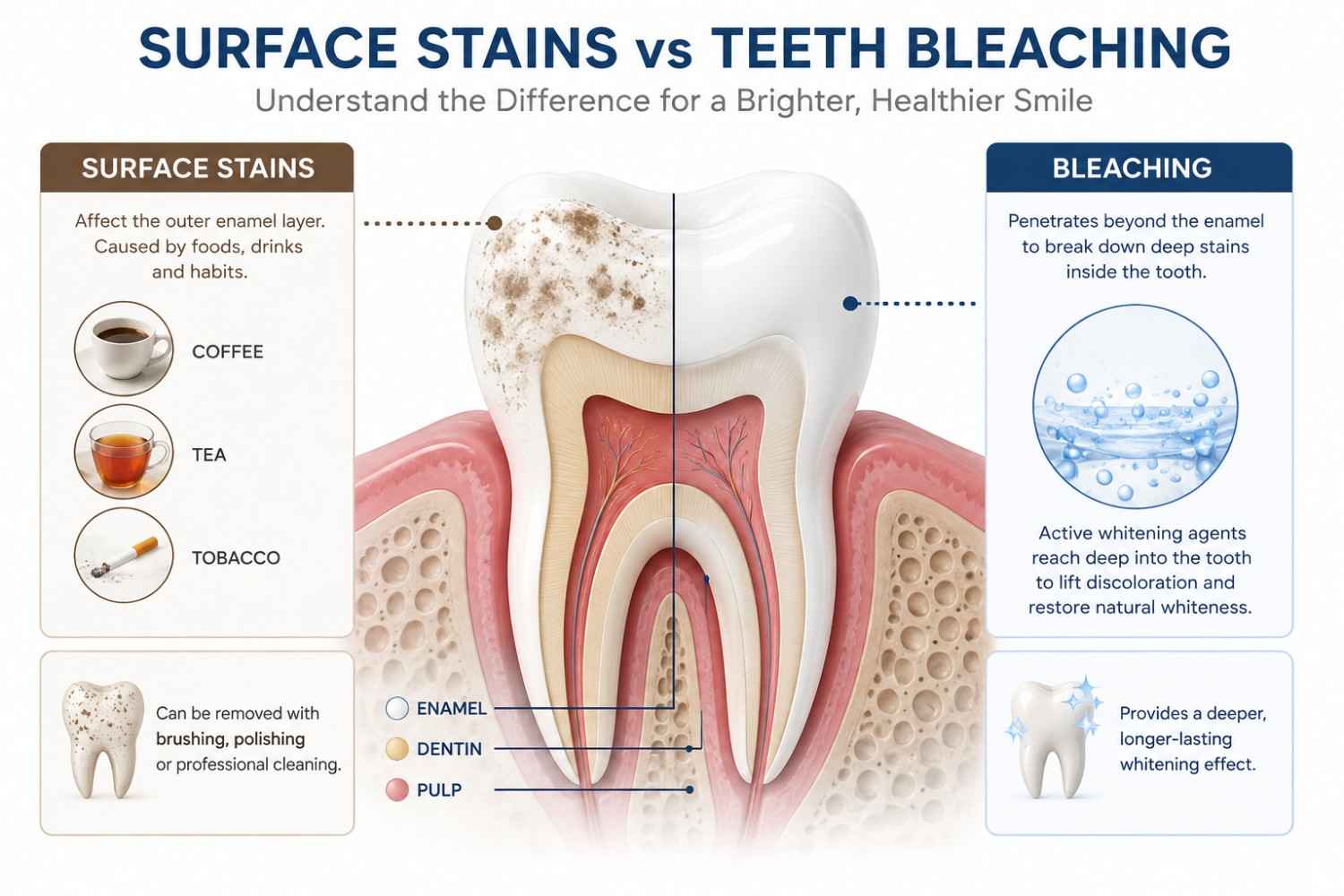
Most DIY whitening remedies do not have strong evidence showing that they safely produce meaningful whitening. Some may temporarily remove surface discoloration, but they are not equivalent to professional or evidence-based peroxide whitening.
There is an important distinction between removing surface stains and bleaching the natural tooth itself.
Surface stains, also called extrinsic stains, can develop from foods and drinks such as:
- Coffee
- Tea
- Red wine
- Tobacco
- Dark sauces
- Certain berries
Whitening toothpastes, for example, primarily work by helping remove these external stains through mild abrasives. Some also contain low levels of peroxide.
Bleaching works differently. Hydrogen peroxide and carbamide peroxide can interact with colored compounds within the tooth, which is why peroxide-based whitening products generally have more evidence behind them than kitchen-based DIY methods.
So, if your goal is a noticeably whiter smile rather than simply cleaner-looking teeth, a properly formulated whitening product is usually a more predictable choice.
7 Popular Teeth Whitening Home Remedies Compared
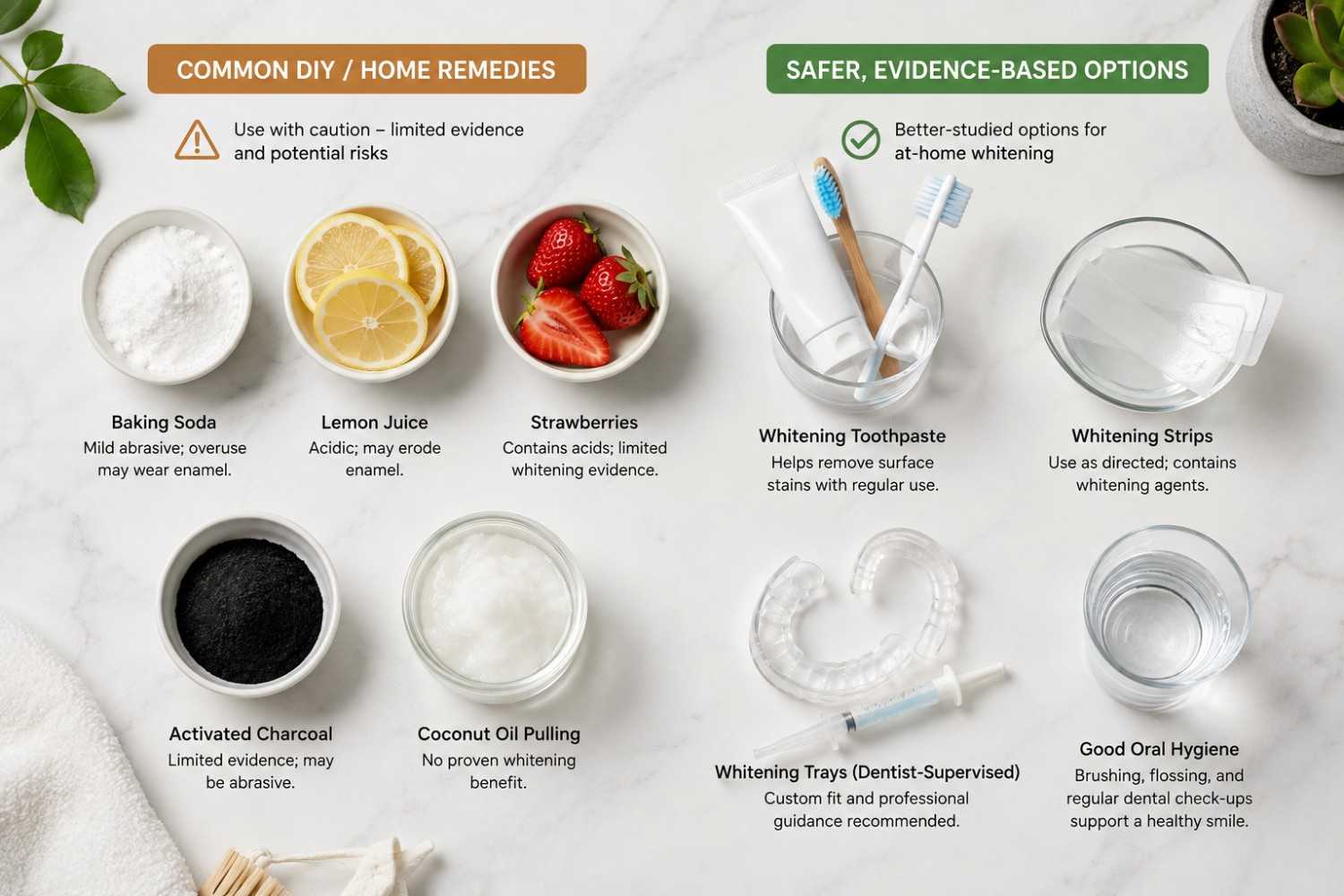
Not every method deserves the same level of caution. Here is how the most commonly discussed options stack up.
| Home remedy | Likely benefit | Main concern | Overall take |
| Baking soda | May help remove surface stains | Abrasive when overused | Use only in appropriate dental products |
| Lemon or citrus juice | Little reliable whitening benefit | Acid can erode enamel | Avoid |
| Strawberries + baking soda | Limited evidence | Acid and abrasion | Not recommended |
| Activated charcoal | Limited whitening evidence | Abrasiveness and uncertain safety | Avoid relying on it |
| Coconut oil pulling | No established whitening benefit | Can distract from proven care | Not a whitening treatment |
| Diluted peroxide | Peroxide can whiten teeth | Incorrect concentration or use can irritate tissues | Don’t improvise |
| Whitening toothpaste | Can reduce surface stains | Results are gradual | Reasonable option |
1. Baking Soda
Baking soda is one of the most popular DIY whitening ingredients because it is mildly abrasive and can help remove some surface discoloration.
The problem is how people use it.
Scrubbing teeth aggressively with loose baking soda can increase abrasion, particularly when combined with a hard-bristled toothbrush or frequent brushing. Removing too much enamel can actually make teeth appear more yellow because the naturally yellowish dentin underneath becomes more visible.
If you like the idea of baking soda, a professionally formulated toothpaste containing baking soda is a more sensible approach than repeatedly brushing with household powder.
2. Lemon Juice and Other Citrus Fruits
This is one of the remedies best left off your bathroom counter.
Lemon juice is highly acidic. Repeated acid exposure can soften dental enamel, and brushing immediately after an acidic exposure can increase mechanical wear while the surface is temporarily softened.
There is also no good reason to accept that risk simply to pursue a whiter smile.
The same caution applies to recipes involving vinegar or other acidic household ingredients.
3. Strawberries and Baking Soda
The strawberry-and-baking-soda mixture has been promoted as a natural alternative to commercial whitening.
However, the ADA reports that research evaluating this combination did not find measurable whitening improvement.
That makes the remedy difficult to justify, especially when better-studied options are available.
4. Activated Charcoal
Charcoal products are widely marketed for whitening, but popularity is not the same thing as evidence.
According to the ADA, there is insufficient evidence that charcoal-based oral-care products provide a measurable whitening benefit with adequate safety and effectiveness.
Some charcoal-and-salt mixtures have also demonstrated abrasive effects in research, raising concerns about excessive removal of tooth structure.
5. Coconut Oil Pulling
Oil pulling involves swishing oil around the mouth, usually for an extended period.
It is often promoted as a natural whitening technique, but there is no established evidence that oil pulling whitens teeth. The ADA notes that documented whitening benefits are lacking.
There is no need to make it part of your whitening routine if your primary objective is changing tooth color.
6. Hydrogen Peroxide
This one requires extra caution.
Hydrogen peroxide is a legitimate whitening ingredient used in properly formulated dental products. It is not the same thing as saying that household hydrogen peroxide should be poured, painted, or repeatedly swished around your mouth.
Concentration, formulation, exposure time, and contact with the gums all matter.
Peroxide-based whitening can cause temporary tooth sensitivity and gum irritation, particularly when used improperly or at higher concentrations.
For that reason, avoid creating your own peroxide whitening recipe. If you want peroxide whitening, use a product specifically formulated for oral use and follow its directions.
What Is a Safer At-Home Alternative?
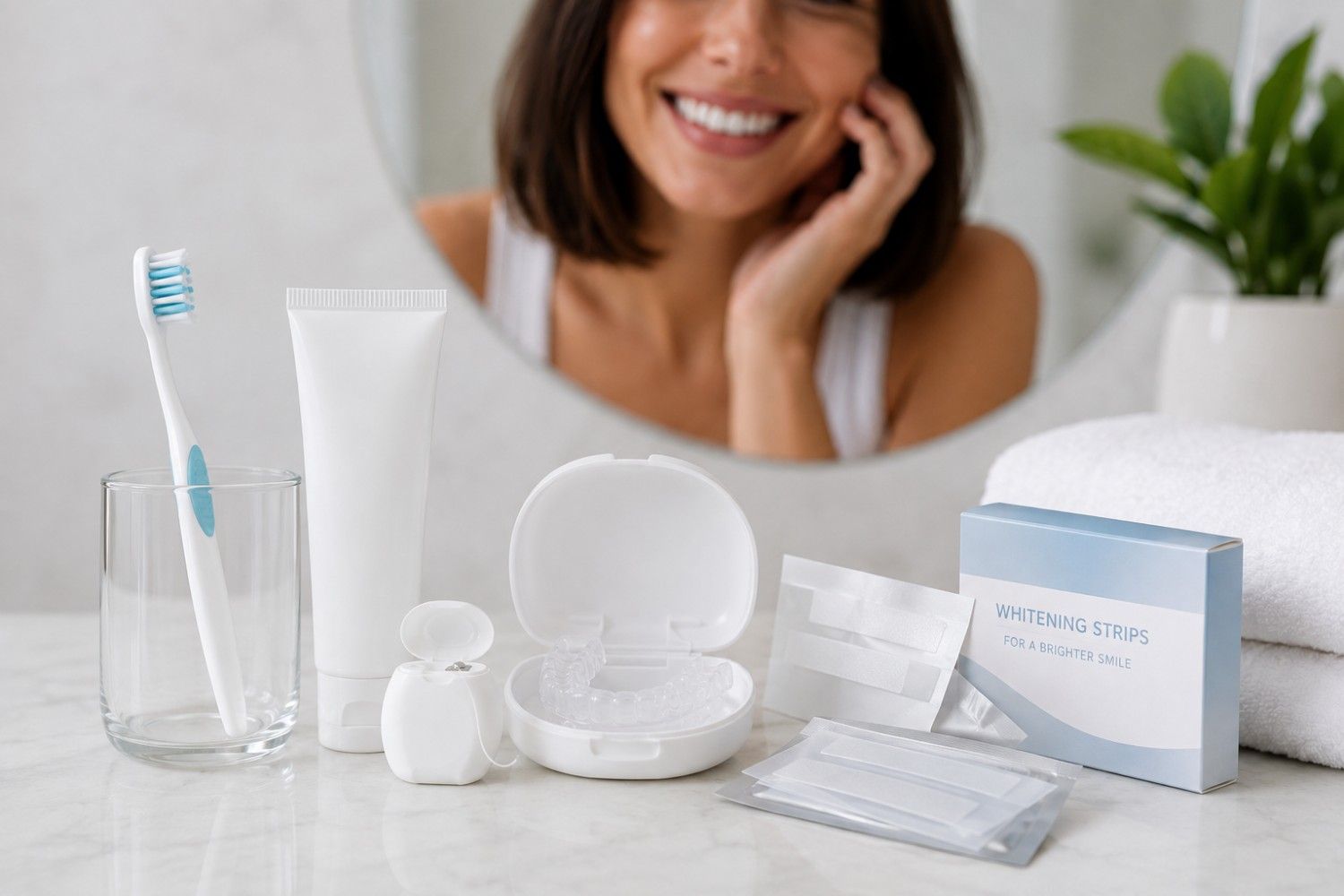
If you want to whiten your teeth at home, consider an evidence-based product rather than experimenting with household ingredients.
Common options include:
Whitening Toothpaste
Whitening toothpaste is generally designed to address surface stains. It is a good choice if your teeth are reasonably healthy and your main concern is discoloration from coffee, tea, or similar foods.
Expect gradual improvement rather than a dramatic transformation.
Whitening Strips
Whitening strips commonly use peroxide to bleach teeth and have better clinical support than many DIY remedies. The ADA notes that whitening strips are among OTC products with evidence supporting their effectiveness, and products carrying the ADA Seal of Acceptance have met the program’s requirements for safety and effectiveness.
Follow the manufacturer’s instructions carefully. Leaving strips on longer than directed does not necessarily produce better results and can increase irritation or sensitivity.
Dentist-Supplied Whitening Trays
A dentist can provide custom trays designed to fit your mouth along with professional whitening gel.
One advantage is control. A dentist can assess your teeth and gums before treatment, identify problems that should be addressed first, and help select an appropriate whitening approach.
The ADA recognizes dentist-supervised at-home whitening as an established treatment option.
How to Make Your Teeth Look Whiter Without Damaging Them
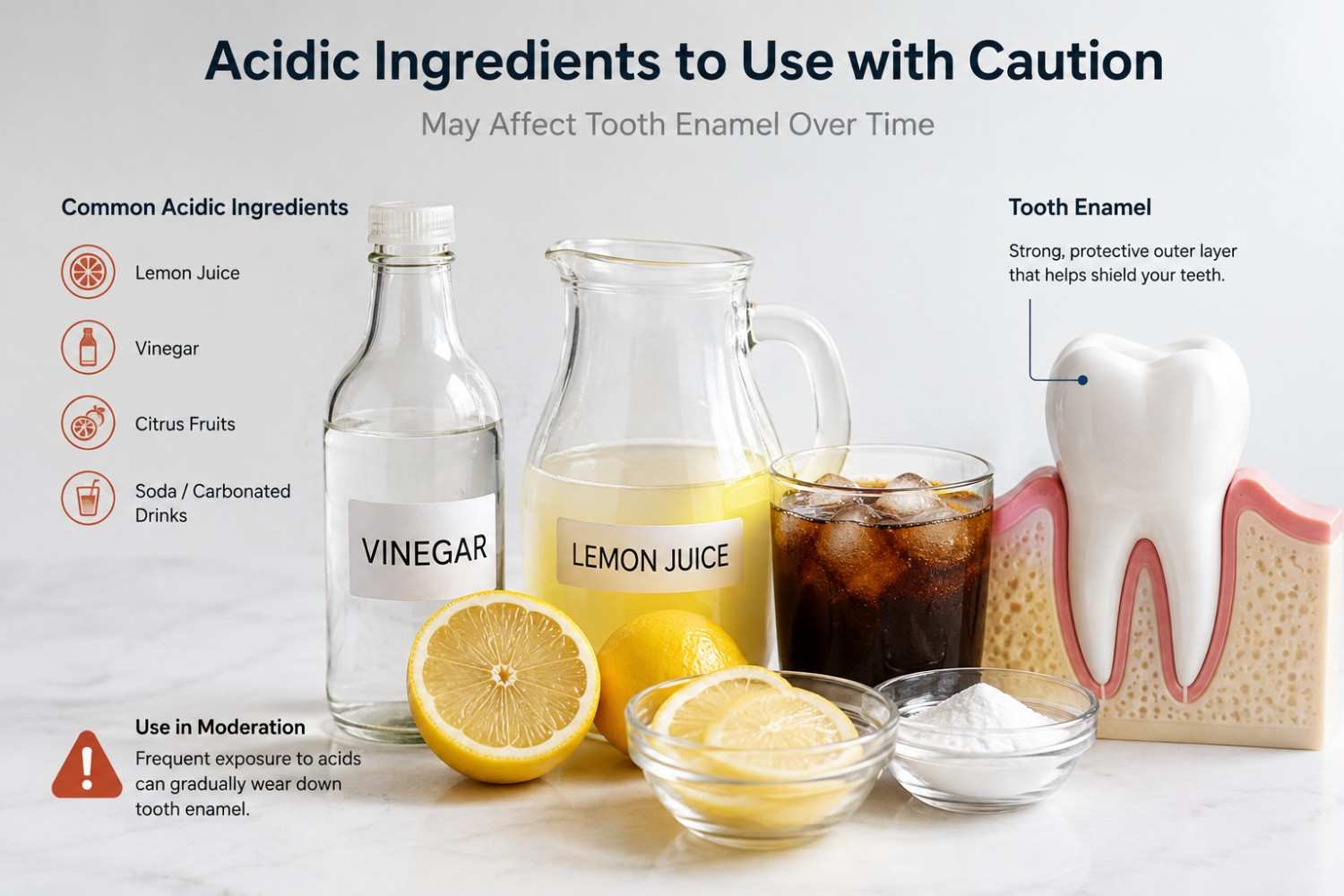
Good whitening results are not only about the product you use.
Keep Surface Stains Under Control
If you regularly drink coffee or tea, rinse your mouth with water afterward. Maintaining consistent brushing and flossing also helps prevent plaque and stain buildup.
Don’t Over-Whiten
More whitening is not automatically better.
Frequent or excessive whitening can increase the likelihood of sensitivity and irritation. Dental professionals have also raised concerns about repeated aggressive bleaching and its effects on enamel.
Follow the recommended treatment schedule instead of extending it because you want faster results.
Give Sensitive Teeth a Break
Temporary sensitivity is one of the most common side effects of tooth whitening. It is generally mild and short-lived, but persistent or severe discomfort should not be ignored.
If whitening makes your teeth uncomfortable, stop the treatment and speak with your dentist before continuing.
Remember That Restorations Do Not Whiten
This is an easy detail to overlook.
Whitening treatments work on natural teeth. Tooth-colored fillings, crowns, veneers, and similar restorations do not respond to bleaching in the same way.
If you have visible dental work on your front teeth, whitening could potentially make the natural teeth lighter while the restoration stays the same color.
Common Mistakes to Avoid
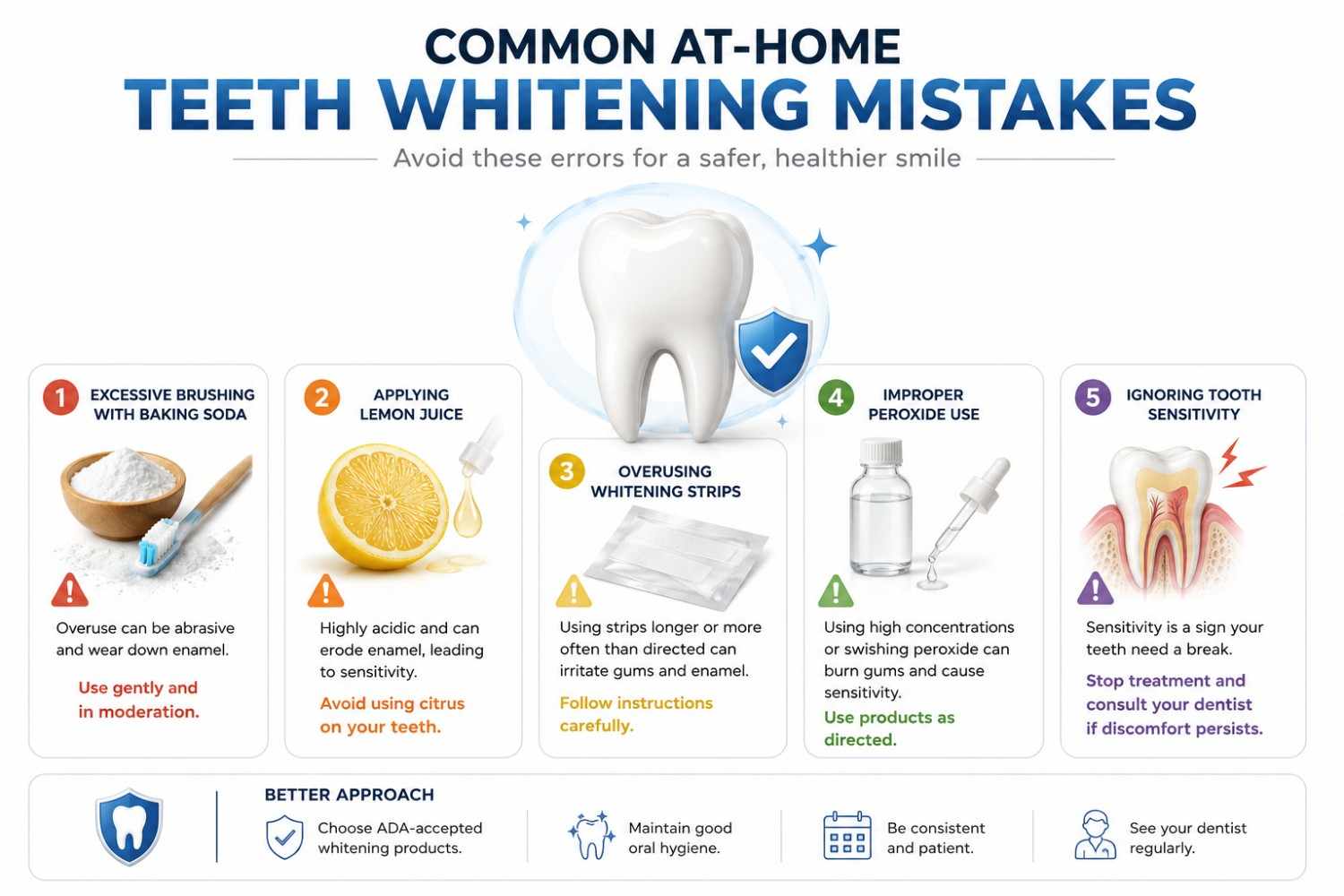
Many whitening problems come from trying to speed up the process.
Avoid these common mistakes:
- Scrubbing aggressively with baking soda
- Applying lemon juice or vinegar to teeth
- Using undiluted or improvised peroxide mixtures
- Leaving whitening strips on longer than instructed
- Whitening every day without following a treatment schedule
- Assuming charcoal automatically means “gentle”
- Ignoring significant tooth sensitivity
- Whitening teeth when you have untreated dental problems
- Expecting crowns or veneers to change color
One of the biggest mistakes is treating a cosmetic concern without considering why the teeth look discolored in the first place.
Yellowing can be related to aging, enamel changes, intrinsic discoloration, medications, dental disease, or previous dental treatment. Not every type of discoloration responds equally well to whitening.
When Should You See a Dentist Before Whitening?
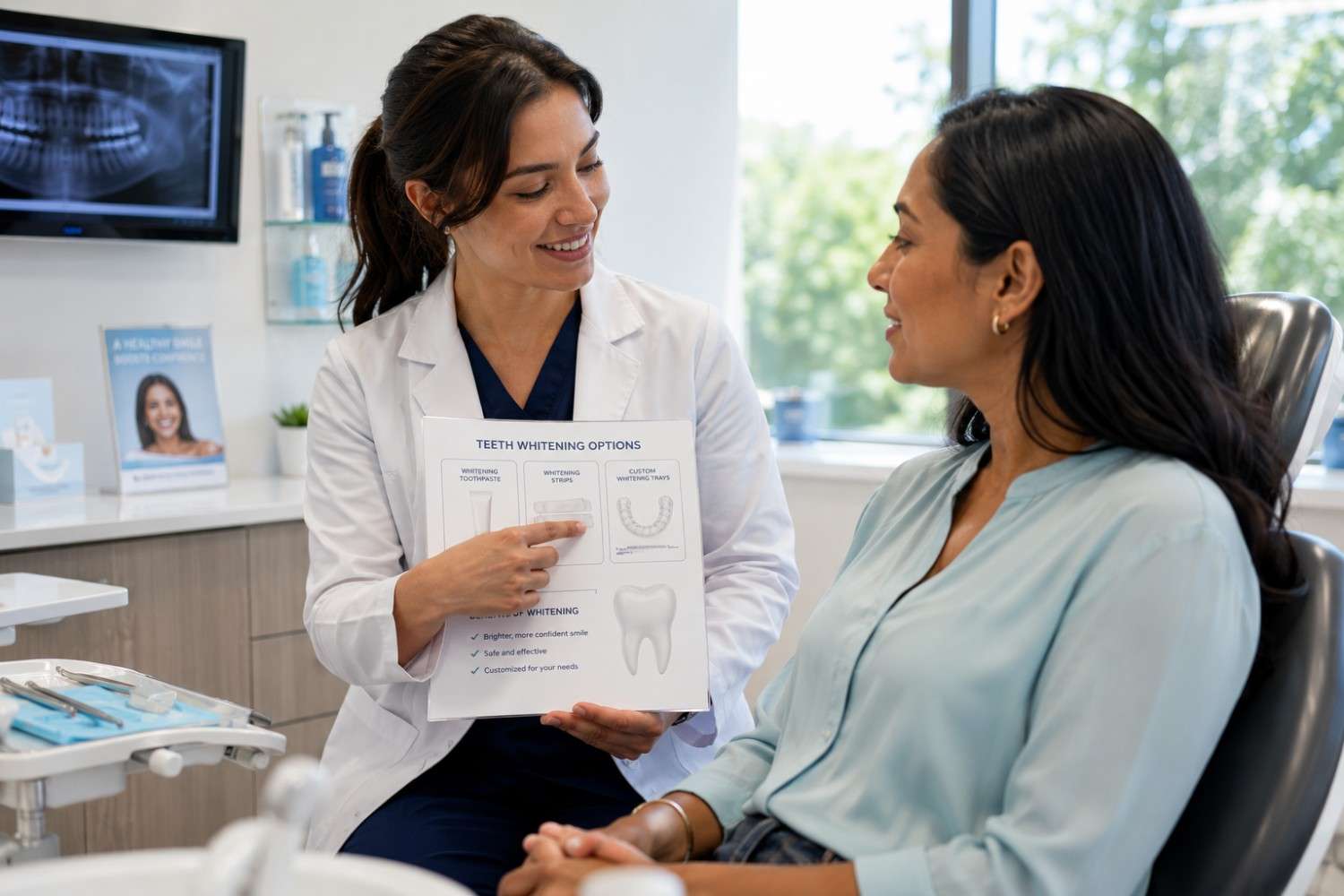
You do not necessarily need a dental appointment before every OTC whitening product. However, professional advice becomes particularly valuable if you have:
- Significant tooth sensitivity
- Tooth pain
- Bleeding or irritated gums
- Cavities
- Cracked or damaged teeth
- Numerous crowns, veneers, or fillings
- Dark discoloration affecting one tooth
- Severe or unexplained discoloration
A dental examination can determine whether whitening is appropriate and whether another problem needs attention first.
For people with sensitive teeth or existing dental concerns, this step can prevent a cosmetic treatment from making an underlying problem more uncomfortable.
FAQ About Teeth Whitening Home Remedies
What is the safest natural way to whiten teeth?
There is no household ingredient that can be recommended as a universally safe and effective tooth-bleaching method. For mild surface stains, maintaining good oral hygiene and using an appropriate whitening toothpaste may be more sensible than experimenting with acidic or abrasive ingredients.
Does baking soda really whiten yellow teeth?
Baking soda may help remove some surface stains because of its abrasive properties, but it does not provide the same type of bleaching action as peroxide. Frequent or aggressive use can also contribute to abrasion.
Is lemon juice good for whitening teeth?
No. Lemon juice is acidic and can contribute to enamel erosion. The potential risk is not worth using it as a DIY whitening treatment.
Can hydrogen peroxide whiten teeth at home?
Hydrogen peroxide is an established teeth whitening home remedies ingredient when properly formulated and used in appropriate products. That does not mean household peroxide should be used as a homemade whitening treatment. Follow the directions for products specifically intended for oral use.
How can I whiten my teeth without damaging enamel?
Choose a properly formulated whitening product, follow the instructions, avoid excessive treatment, and address existing dental problems first. If you have sensitivity or restorations, ask a dentist which option is appropriate.
Final Conclusion
The most important thing to understand about teeth whitening home remedies is that inexpensive and natural do not necessarily mean effective or safe.
Baking soda may help with surface stains, but aggressive scrubbing is a poor strategy. Lemon juice, vinegar, and other acidic recipes should be avoided. Charcoal and oil pulling do not have convincing evidence as whitening treatments, while strawberry-and-baking-soda mixtures have not demonstrated measurable whitening in research cited by the ADA.
If you want noticeable whitening at home, consider an established whitening toothpaste, whitening strips, or dentist-supervised whitening rather than experimenting with kitchen ingredients.
Most importantly, treat whitening as a dental-care decision—not just a cosmetic hack. A healthier mouth gives you a better starting point, and a dentist can help determine whether your discoloration is something that bleaching can realistically improve.
Read More: Smile Teeth Whitening Kit